The Spey rises in the Monadhliath hills and reaches the Moray coast about a hundred miles later, and the farmland along its lower reaches and its tributaries is a stretch a car crosses in about an hour. Small towns, barley, and a great deal of weather. It also holds more working malt distilleries than any comparable piece of ground anywhere, somewhere near fifty depending on who is counting and what counts as working. That density is the first fact anyone offers about the place, and it is the least useful one, because it says nothing at all about what the fifty are making.
Speyside is a region before it is a flavour. The Scotch Whisky Regulations protect five geographical names, three regions and two localities, and Speyside is one of the three, drawn inside Highland ground rather than beside it, and some of the largest houses there print Highland on the label instead. The word has been doing commercial work for a long time. Through the nineteenth century and well past it, distilleries for miles around the parish of Glenlivet hyphenated Glenlivet onto their own names, until the glen on the labels was larger than the glen on any map. A place name that sells will spread. The flavour never followed it.
The two words doing the most work on a Speyside label are bourbon and sherry, and they are not describing the same kind of thing. American white oak is rich in the lactones that read as coconut and vanilla, and comparatively low in tannin. European oak runs the other way, with less lactone and far more tannin, which arrives as grip, dryness and colour. Toasting and charring break the lignin in the staves down into vanillin before any spirit goes in. A sherry cask can be built from either species. The label says sherry and means the wine. The wood is the larger variable.
Neither cask is in Scotland by design. American law requires bourbon to be matured in new charred oak, which leaves a barrel that cannot serve that purpose twice and a buyer in the north who has a use for it. Sherry arrived by a different route. The wine once crossed to Britain in cask, and the empty butts were simply there, cheap and near every port. That supply ended when sherry had to be bottled where it was made. What stands in its place is a seasoning trade: casks coopered, filled with sherry for a spell, emptied, and sent north to hold something else. The tradition is now a commission.
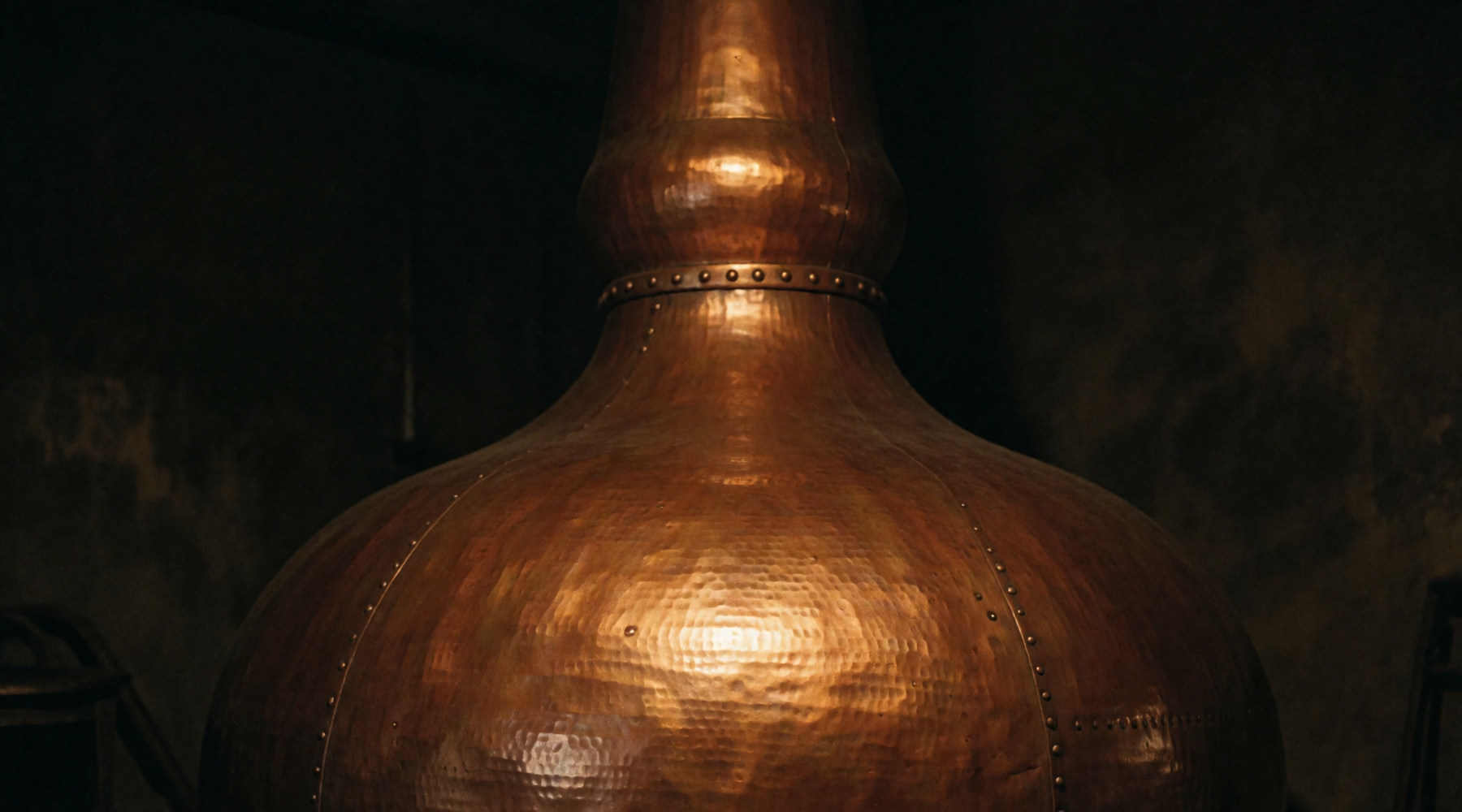
If the wood does that much, house style starts to look like a story a distillery tells about itself. Part of that suspicion holds. Colour proves nothing at all, since spirit caramel is permitted in Scotch and a dark whisky may be dark by permission rather than by cask. The rest does not hold. Fermentation length decides how much fruit the wash throws before distillation begins. Still shape and the speed of the run decide how much heavy material makes the crossing. The cut decides the rest. Two houses filling identical casks from the same cooper will not arrive at the same whisky, because most of what separates them was settled in the washbacks and the stillhouse before anyone chose a cask.
Two glasses of the same distillate, one from a refill hogshead and one from a first fill butt, do not look alike. The pale one holds the light and gives back straw and a little gold. The dark one absorbs it and returns a rim of red where the liquid meets the glass. The distillery is in both of them. Only one looks like the thing the region is famous for.